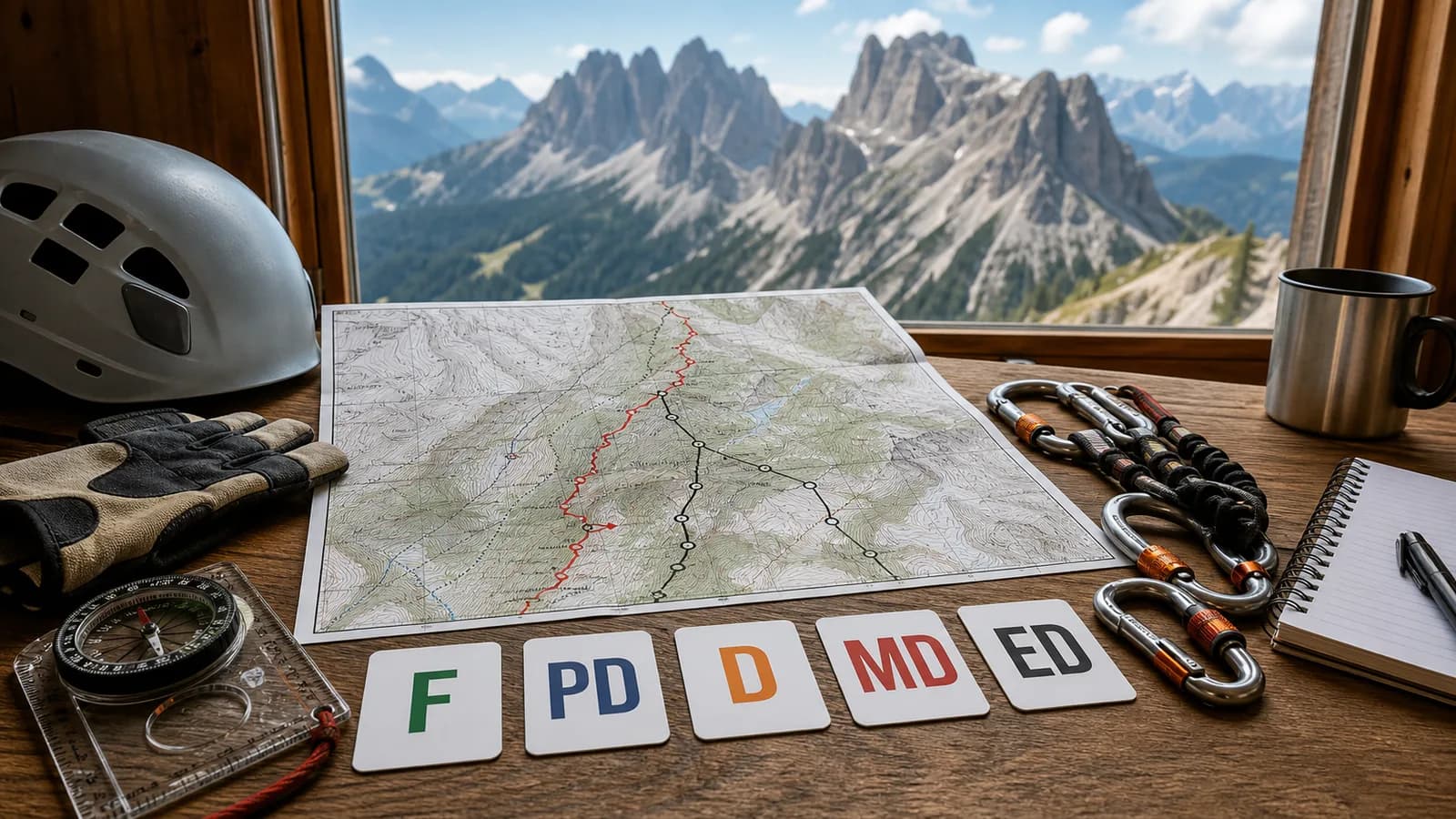
Via ferrata difficulty: grades F, PD, D, MD, and ED
Complete guide to via ferrata difficulty grades: CAI scale F, PD, D, MD, and ED, comparison with Hüsler K1-K6 and Schall scales, risks, and route planning.
Letters and labels are only the start
Airiness can matter more than moves
Total time, elevation and descent count
Via ferrata difficulty: how to read the grades
The difficulty of a via ferrata indicates the technical and overall commitment required by the route. In Italy, the CAI classification uses the abbreviation EEA (Escursionisti Esperti con Attrezzature - Experienced Hikers with Equipment), followed by the grades F, PD, D, MD, and ED: Easy, Slightly Difficult, Difficult, Very Difficult, and Extremely Difficult. The grade helps you compare routes, but it is not enough on its own to decide if a via ferrata matches your level. Duration, exposure, continuity, elevation gain, altitude, approach, descent, and mountain conditions can significantly increase the actual difficulty.
- EEA-F: Easy via ferrata
- EEA-PD: Slightly difficult via ferrata
- EEA-D: Difficult via ferrata
- EEA-MD: Very difficult via ferrata
- EEA-ED: Extremely difficult via ferrata
The CAI via ferrata difficulty scale
The Italian Alpine Club (CAI) classifies via ferratas as EEA itineraries, meaning they are intended for experienced hikers with equipment. The letters following EEA describe the increasing difficulty of the route. This scale considers characteristics such as exposure, verticality, continuity, quality of natural holds, and the quantity of artificial metal structures. Evaluations can still vary between route reports, guidebooks, and seasons: always compare multiple up-to-date sources and read the complete route description before setting off.
- The EEA label does not mean all via ferratas have the same difficulty; it identifies the activity type and the need for specific safety equipment
- The reported grade can refer to the overall difficulty or only the most challenging section of the route
- Plus and minus signs, like PD+ or D-, are sometimes used to indicate intermediate difficulty levels
- A recent route report is more useful than a single grade, especially after maintenance, rockfalls, or changes to the equipment
EEA-F: Easy via ferrata
An easy via ferrata typically features a low-exposure, well-protected, and technically moderate route. The cable, chains, and any metal fixtures facilitate progression, while natural holds are numerous. Brief vertical sections may be present, but normally without requiring sustained athletic effort. Easy does not mean risk-free: a helmet, harness, via ferrata set with an energy absorber, correct technique, and the ability to move in a mountain environment are still required.
- Suitable for a first experience only with instruction, stable weather, and competent companionship
- Requires sure-footedness on the access and descent trails, and absence of vertigo
- Can become demanding if it is long, at high altitude, wet, crowded, or has a complex descent
- For a beginner, a short EEA-F route with a simple approach and possible escape routes is preferred
EEA-PD: Slightly difficult via ferrata
An EEA-PD via ferrata develops on a more complex path, with gullies, chimneys, vertical passages, and exposed sections. Metal equipment still heavily aids progression, but better coordination, stamina, and comfort with heights begin to be required. A short and well-equipped PD route can be suitable for someone who has already learned the basic techniques, whereas a long, alpine PD route can require more commitment than a very short, sporty D route.
- Requires fluid carabiner handling and the ability to choose efficient natural holds
- May include vertical ladders, exposed traverses, and passages that fatigue the arms
- Should only be chosen as a first experience if there is a safe margin, expert support, and a favorable route report
- Carefully check the length, total elevation gain, and difficulty of the descent
EEA-D: Difficult via ferrata
A difficult via ferrata often features steep or vertical walls, greater exposure, and more sustained technical passages. Artificial steps can be less numerous, making it necessary to make better use of the natural rock. Good physical preparation, proper progression technique, the ability to rest your arms, and mental focus on exposed sections are required. The jump from PD to D is significant: someone who easily completes slightly difficult via ferratas is not automatically ready for a D route.
- Suitable for experienced and fit climbers, not for a first outing
- Can include tiring traverses, vertical walls, chimneys, and short extremes or overhangs
- The continuity of the D grade matters as much as the single hardest passage
- Relying on the via ferrata lanyard to rest does not substitute for technique, fitness, and proper planning
EEA-MD: Very difficult via ferrata
EEA-MD via ferratas are highly demanding itineraries, with vertical or overhanging passages, strong exposure, and metal equipment that may offer less assistance for progression. They require strength, endurance, consolidated technique, and excellent mental management. On these routes, a mistake in assessment can quickly lead to exhaustion, panic, or the need for rescue. They are intended for climbers with progressive experience on difficult routes and a solid physical margin.
- Requires excellent physical condition and the ability to move efficiently to conserve energy
- Key passages can be long, continuous, and difficult to escape from
- Crowds, heat, or a heavy backpack significantly increase fatigue
- Before choosing an MD route, check for escape routes, resting points, and the difficulty of the descent
EEA-ED: Extremely difficult via ferrata
An EEA-ED via ferrata represents the highest level on the Italian scale. It can include long overhanging sequences, highly technical passages, very few artificial holds, and extreme exposure. Preparation comparable to advanced vertical activities is required, along with specific experience, strength, and great endurance. These itineraries are not a normal touristic evolution of via ferratas: they are selective routes for highly trained and aware climbers.
- Reserved for experienced climbers with specific training and very solid technique
- May require continuous use of natural holds on vertical or overhanging terrain
- Attempting a route at your limit increases the risk of a fall, getting stuck, or complex rescue scenarios
- Turning back early is the correct decision when experience, weather, or fitness do not offer a safe margin
Difference between technical difficulty and overall commitment
Two via ferratas with the same grade can be profoundly different. A D route with a single hard passage near the start is not equivalent to a continuous D route spanning hundreds of meters. The maximum grade often describes only the single most challenging section, while the overall commitment also depends on the length, availability of resting points, altitude, and the complexity of the entire day. To choose wisely, always separate the question "how difficult is the hardest passage?" from "how demanding is the entire via ferrata?".
- Technical difficulty: verticality, holds, distance between rungs, balance, and required strength
- Continuity: frequency and duration of challenging sections without real recovery zones
- Physical effort: total hours, elevation gain, approach hike, backpack weight, altitude, and temperature
- Psychological effort: exposure, bridges, traverses, remoteness, and escape options
Exposure and vertigo: why the grade is not enough
Exposure describes the feeling of height and the perceived consequences of a fall. A technically easy via ferrata can be very demanding for someone sensitive to heights, especially on ridges, suspension bridges, or airy traverses. Conversely, a physically strong athlete might underestimate the psychological impact of a vertical wall. True vertigo and fear of heights are not the same, but both require caution: your first test should take place on a short, easily escapable instructional route.
- Look in the route description for words like exposed, airy, traverse, bridge, and ridge
- Look at the elevation profile and map rather than just selected photos of the most spectacular sections
- Avoid discovering your reaction to heights on a long via ferrata or one without escape routes
- If someone freezes, group pressure and rushing will only make the situation worse
Duration, elevation gain, and altitude increase the difficulty
The total time includes the approach hike, the equipped section, breaks, possible queues, and the descent. A short D-grade via ferrata can require less energy than a long PD route with a thousand meters of elevation gain. Altitude also affects performance: cold, wind, lack of acclimatization, and residual snow can slow down the group. Therefore, evaluate technical difficulty and physical load as two separate elements, always adding a realistic buffer to the stated times.
- Approach time: impacts the energy levels available when starting the climb
- Total elevation gain: includes the climb and often a long or steep descent hike
- Maximum altitude: can bring cold, wind, snow, and faster weather changes
- Daylight hours: determine the available safety margin in case of queues or delays
Weather and conditions can change the actual grade
Rain, ice, snow, wind, and thunderstorms do not change the official grade, but they can make a via ferrata much more difficult or impossible to climb. Wet rock reduces grip, cold gloves decrease precision, and the metal cable is particularly dangerous during electrical activity. Even an easy itinerary must be postponed when conditions are unfavorable. Always check local forecasts, route status, and recent reports before setting off.
- Thunderstorms: avoid the route if there is any risk of electrical activity during your planned window
- Rain: rock, rungs, and descent trails become slippery
- Snow and ice: can cover the cable, natural holds, and trail markers
- Heat: increases dehydration and fatigue on rock faces exposed to the sun
- Wind: makes balance, communication, and progression on bridges much harder
European scales: A-F, K1-K6, and Italian grades
Outside of Italy, you will encounter different grading systems. In Austria, South Tyrol, and part of the eastern Alps, the Schall scale from A to E or F is common, with intermediate levels like B/C. In Switzerland and some German-language guidebooks, the Hüsler scale from K1 to K6 is used. The correspondences with F, PD, D, MD, and ED are only indicative, as each system assesses and describes routes slightly differently. Never convert a grade automatically: always read the legend, topo, and description of the source guidebook.
- Italian CAI scale: EEA-F, EEA-PD, EEA-D, EEA-MD, EEA-ED
- Schall scale: A, B, C, D, E, and sometimes F, with intermediate grades
- Hüsler scale: K1, K2, K3, K4, K5, and K6
- An equivalence table is only for orientation and does not replace the specific route report
Which difficulty to choose for your first via ferrata
For your first experience, choose a short, well-equipped EEA-F via ferrata with a clear approach, simple descent, and options to exit the route early. An EEA-PD can be considered only if the route report describes a short itinerary and the group is accompanied by a mountain guide, an instructor, or a competent partner. The first outing should teach technique and vertical movement, not test your courage.
- Choose based on the least experienced and least fit person in the group
- Keep the total duration short and set off with stable weather forecasts
- Avoid famous but long, highly crowded, or escapeless routes
- Rent or carefully check a certified helmet, harness, and via ferrata set
- After your first route, increase only one variable at a time: grade, duration, altitude, or exposure
How to know if you are ready for a harder via ferrata
The transition to the next grade should occur when you complete the current level with a safe margin, without exhausting your arms, losing focus, or significantly slowing down the group. Reaching the top is not the only criterion: how you managed technique, pacing, fear, nutrition, and the descent all count. If you finished a PD route at your absolute limit, the correct choice is not a D, but another PD that is longer or slightly more exposed to consolidate your experience.
- Always maintain three points of contact when possible and use your legs more than your arms
- Manage carabiners calmly, without rushing, errors, or crossing your arms
- Reach the end of the equipped section with energy left to tackle the descent hike
- Be ready to turn back when weather, crowds, or conditions do not match the plan
- Ask a mountain guide or instructor for an evaluation before making significant jumps in grade
Common mistakes in assessing difficulty
The most frequent mistakes are choosing a route based on photos, considering only the hardest single passage, copying the timing of fitter groups, and confusing physical strength with mountaineering experience. Relying on a single online review can also be misleading: the perception of difficulty, conditions, and fitness vary from person to person. Cautious planning uses technical data, topos, recent reports, weather, and the actual capabilities of the group.
- Underestimating the approach and descent because they are not part of the equipped section
- Thinking an easy via ferrata is automatically suitable for children or absolute beginners
- Increasing technical grade, duration, altitude, and exposure all at the same time
- Ignoring queues and the impossibility of overtaking on vertical sections
- Starting a route without knowing the escape options, key sections, and the cutoff time to turn back
How to compare difficulties on Sferrati
On Sferrati, you can use the route pages and the map to compare difficulty, duration, elevation gain, location, and other available data. Start with the grade, then check the complete picture: total time, maximum altitude, approach, route status, and travel distance. For a safe choice, compile a shortlist of multiple itineraries and keep a simpler or lower-altitude alternative in mind in case weather and conditions change.
- Initially filter for a grade lower than your maximum technical limit
- Compare duration and elevation gain between routes of the same grade
- Check the position on the map to assess travel time, altitude, and general exposure
- Open the complete route sheet before deciding and verify conditions with updated local sources
Quick table of via ferrata difficulties
In summary, EEA-F indicates an easy and well-protected via ferrata; EEA-PD introduces more complex terrain, verticality, and exposure; EEA-D requires experience, technique, and good fitness; EEA-MD features highly challenging and often overhanging passages; EEA-ED is reserved for highly trained experts. This summary serves as a guide, but the final choice must always consider the complete route report and the conditions of the day.
- F: easy, low exposure, and technically moderate
- PD: slightly difficult, more vertical, exposed, and varied terrain
- D: difficult, steep, technical, and physically demanding
- MD: very difficult, sustained, exposed, and often overhanging
- ED: extremely difficult, selective, and reserved for experts
Conclusion: choose your grade with a margin
The via ferrata difficulty scale is a planning tool, not a leaderboard to climb. The right route is the one that the group can complete while maintaining proper technique, mental clarity, and energy for the descent. Always read the grade in conjunction with exposure, continuity, duration, elevation gain, altitude, weather, and conditions. When in doubt between two via ferratas, choose the easier one: a safety margin is an essential part of mountain safety.