What is a via ferrata? Complete Guide 2026
Discover what a via ferrata is, how it works, what equipment is required, difficulties, risks, costs, and tips to tackle your first route safely.

Helmet, harness and ferrata lanyard
Between hiking and climbing
Easy, short and ideally guided
What is a via ferrata: a simple definition
A via ferrata is a mountain path equipped with a continuous or near-continuous steel cable, anchors, rungs, steps, ladders, and sometimes suspension bridges. These structures facilitate progression on walls, ledges, and exposed sections that would be difficult to traverse as a normal trail. Those who tackle it wear a helmet, harness, and a specific via ferrata set with an energy absorber, clipping onto the cable during the equipped sections. The presence of the cable does not eliminate the risk: a via ferrata remains a mountain activity that requires preparation, correct equipment, and the ability to assess weather, difficulty, and route conditions.
- Via ferrata literally means iron path, referring to the metal elements fixed to the rock
- The cable helps progression and serves as the connection point for the via ferrata set
- Rungs, pegs, ladders, and bridges allow climbers to overcome vertical walls or exposed passages
- Helmet, harness, and via ferrata set with energy absorber are the essential personal equipment
How a via ferrata works
During progression, the two carabiners of the set are clipped onto the cable. When encountering an anchor, you transfer one carabiner to the next section and only then move the second one, ensuring you maintain at least one connection. The energy absorber is designed to reduce the force transmitted to the body in a fall, but a fall on a via ferrata can still be severe due to the distance between anchors and the risk of impacting rock, rungs, or the cable. The technique should be learned through a course, a mountain guide, or a truly competent person, not just by reading an online guide.
- Always stay connected to the cable following the technique taught in courses and the set manual
- Maintain sufficient distance from the climber ahead of you, never sharing the same cable section between anchors
- Use your legs and natural rock holds to save arm strength, especially on vertical sections
- Do not improvise knots, lanyards, or resting systems not approved by the manufacturer
Via ferrata, equipped trail, and climbing: differences
A via ferrata features continuous or frequent equipment and typically requires a via ferrata set with an energy absorber. An equipped trail (sentiero attrezzato) uses cables, chains, or steps only in specific passages to facilitate a route that is predominantly hiking, although exposure and risk can still be significant. Climbing, on the other hand, is done using natural holds and belaying techniques with a rope, partner, and protection. The boundaries are not always sharp: this is why you must read the specific description of the route, rather than relying solely on the name.
- Via ferrata: cable and metal equipment characterize a substantial part of the itinerary
- Equipped trail: hiking path with metal protections or aids at specific points
- Climbing: technical progression on rock with belay systems distinct from a via ferrata set
- An equipped path does not automatically mean easy or suitable for beginners
How difficult is a via ferrata
The difficulty of a via ferrata depends on verticality, exposure, continuity, quality of natural holds, distance between anchors, and the required physical strength. In Italy, you will often see the grades F, PD, D, MD, and ED, ranging from easy to extremely difficult, but the technical grade is only one part of the assessment. Total duration, elevation gain, altitude, approach, escape routes, descent, and cable conditions can turn an apparently moderate via ferrata into a demanding day.
- F, easy: moderate commitment, but equipment and basic skills are still required
- PD, slightly difficult: increased exposure or more vertical passages
- D, difficult: athletic, vertical, or continuous sections requiring experience
- MD and ED: very challenging itineraries, reserved for fit and technically prepared climbers
- Always compare the grade with total time, elevation gain, altitude, descent, and recent conditions
Required equipment for via ferrata
The basic gear includes a climbing helmet, a harness, and a certified via ferrata set with an energy absorber. You also need high-grip shoes, gloves, layered clothing, water, food, sun protection, a charged phone, a small first aid kit, and gear suitable for the altitude and season. A standard climbing cord does not replace a via ferrata set. Before every outing, check manuals, compatibility, wear, production date, and any product recalls.
- Certified climbing helmet, properly adjusted and worn even during approaches and exposed breaks
- Harness of the correct size, adjusted according to the manufacturer instructions
- Via ferrata set with EN 958 certified energy absorber and specific carabiners
- Approach or hiking shoes with a grippy sole and good stability
- Via ferrata gloves, compact backpack, water, layers, headlamp, and first aid kit
How to choose your first via ferrata
Your first via ferrata should be easy, short, well-equipped, and have a simple approach and descent. Choose a day with stable weather, start early, and go with a mountain guide, an organized course, or a truly experienced partner. For your first experience, avoid famous but long, highly exposed, or crowded routes: the view matters less than having enough energy margin to learn the movements, carabiner management, and reaction to heights without getting exhausted.
- Look for F or PD difficulty grades and a recent, detailed route report
- Prefer short durations, moderate elevation gain, and routes with possible early exits
- Verify opening status, maintenance, residual snow, and descent conditions
- Avoid thunderstorms, high winds, wet rock, and days with extreme temperatures
- If you suffer from vertigo or fear of heights, try an instructional route with a professional first
How long does a via ferrata take
A via ferrata can take less than an hour or fill an entire day. The time for the equipped section alone is not enough: you must add the approach, potential waiting times, breaks, descent, and margin for emergencies. A large or inexperienced group moves slower, while crowds and bottlenecks can create queues. To plan correctly, use the total time indicated in the route description and compare it with the elevation gain, distance, altitude, and available daylight hours.
- Approach: from the parking lot or refuge to the start of the via ferrata
- Equipped section: actual time spent on the cable, ladders, rungs, and bridges
- Descent: often tiring and not necessarily easier than the climb
- Margin: add buffer time for queues, navigation, breaks, and weather changes
What are the risks of a via ferrata
The main risks include falls, rockfall, thunderstorms, lightning strikes on the metal cable, wet rock, residual snow, equipment failures, fatigue, panic from exposure, and mistakes in progression. Other climbers can also increase the danger by dropping rocks or stopping in the wrong places. Always check the weather forecast, official route status, and recent reports; if you find damaged cables, loose anchors, or a closure, turn back and report the issue to the competent authorities.
- Storms and lightning: the metal cable makes it essential to avoid unstable weather
- Rockfall: always wear a helmet and keep a safe distance from other groups
- Fatigue: increases errors, slows speed, and makes managing carabiners harder
- Damaged equipment: do not bypass closures and do not rely on doubtful cables or anchors
- Descent: save energy, water, and daylight for the return journey
When to climb a via ferrata
The best season varies by altitude, exposure, and region. At low altitudes, spring and autumn offer pleasant temperatures, while many alpine and Dolomite routes become accessible in summer after the snow melts. In high mountains, snow and ice can persist late into the season. In summer, afternoon thunderstorms are common: consult reliable local forecasts, start early, and turn back if the weather margin is insufficient.
- Spring: watch out for residual snow, snowmelt, loose rocks, and swollen streams
- Summer: long days but higher risk of heat and afternoon thunderstorms
- Autumn: cooler temperatures, shorter days, and potential ice in shaded sections
- Winter: many routes require winter mountaineering skills and gear or are closed
Via ferrata with children
A via ferrata with children requires a much more cautious evaluation of their age, weight, height, strength, attention span, and comfort with heights. The child must fall within the weight range of the via ferrata set and be able to reach and manage the cable. In many cases, additional belaying with a rope by a competent person is necessary. Just because a via ferrata is graded easy does not mean it is suitable: consult a mountain guide or a qualified instructor and choose educational routes specifically designed for kids.
- Check the minimum and maximum weight limits stated in the via ferrata set manual
- Ensure the child can reach the cable, pegs, and holds without strained movements
- Consider fear, focus, cold, and fatigue ahead of technical difficulty
- Do not improvise rope belaying without specific training
Can you climb a via ferrata alone
Climbing a via ferrata alone increases the consequences of a mistake, injury, or psychological block. For a beginner, it is not recommended. Even an experienced climber must assess phone coverage, route traffic, weather, escape options, and rescue accessibility. Always communicate your itinerary and expected return time, carry the emergency number, and never rely on the presence of other climbers on the path as a substitute for a partner.
- For your first experience, hire a guide, join a course, or go with a competent partner
- Leave your route details, parking location, and latest return time with a trusted contact
- Download maps and route information before you lose cell service
- In case of doubt or unexpected conditions, turn back early
How much does a via ferrata cost
Most via ferratas are free to access, but an outing involves costs for equipment, travel, parking, cable cars, mountain huts, and potentially a guide. A complete personal kit requires a helmet, harness, and a via ferrata set with an energy absorber; for your first time, renting checked gear from a guide or specialized shop is often more convenient. Price should never drive you to purchase used or questionable safety gear, as the history of an energy absorber cannot be verified by visual inspection.
- Access: usually free, except for cable cars, tolls, parking, or private areas
- Rental: a practical solution to try out the activity with modern, correctly sized, and checked gear
- Purchase: cost-effective if you plan regular outings and know how to inspect and store the gear
- Guide or course: a valuable investment to learn technique, planning, and risk management
How to find via ferratas near you
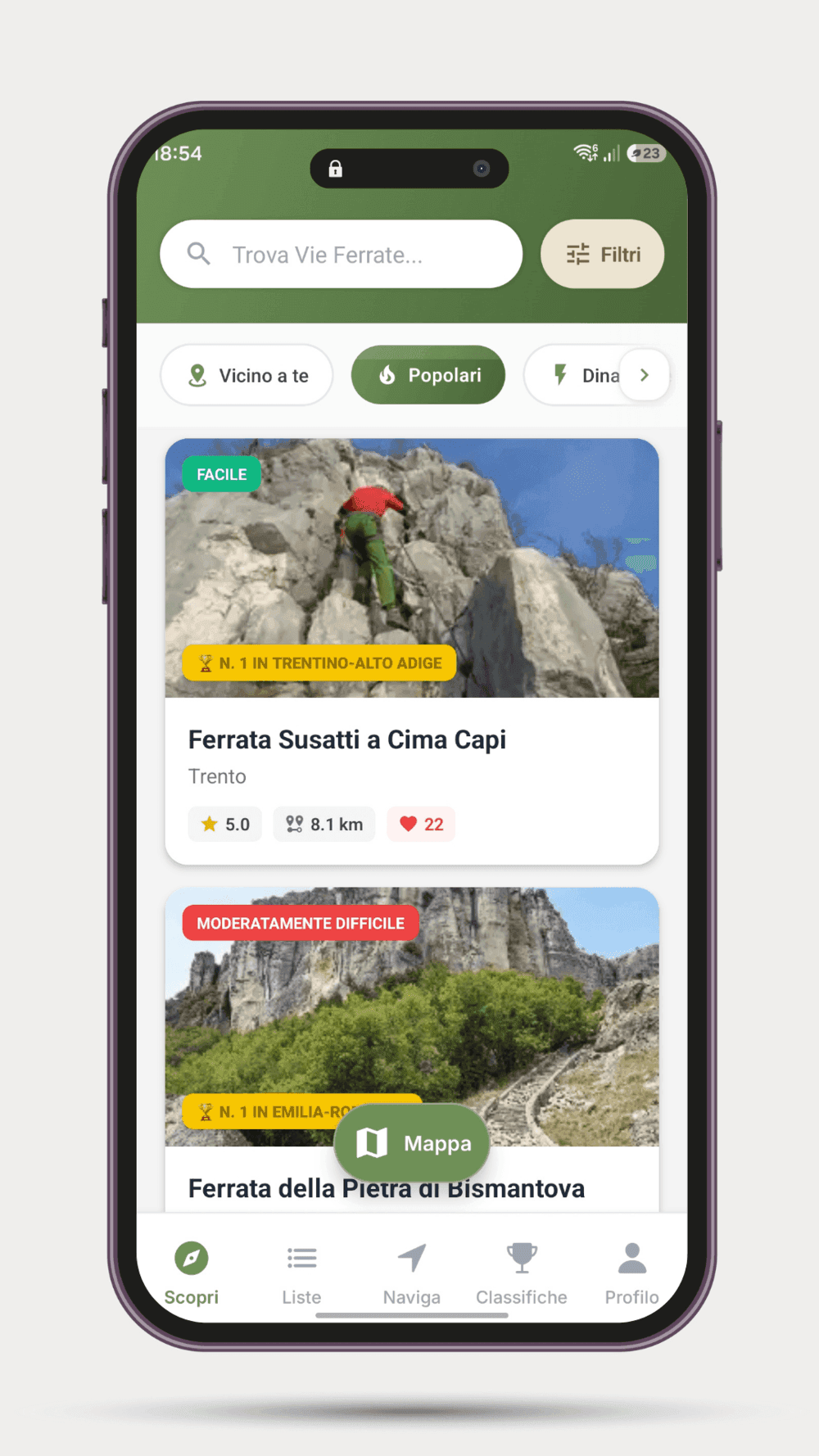
To find a via ferrata near you, use a dedicated map and filter routes by region, difficulty, duration, and elevation gain. Do not choose based solely on distance: compare altitude, exposure, approach, descent, and opening status. On Sferrati, you can explore detailed route sheets, view them on the map, and compile a list suitable for your experience level. Always verify route details with local sources and official updates before setting off.
- Start from the map to locate via ferratas that are realistically reachable
- Compare multiple itineraries instead of focusing solely on the most famous route
- Read the technical data, description, approach, and descent before deciding
- Check closures, maintenance, and recent conditions the day before and the morning of the climb
Summary: is via ferrata right for you
Via ferrata is a spectacular way to enter rocky and exposed environments without practicing traditional climbing, but it is not a risk-free shortcut. If you are sure-footed, physically prepared, have certified equipment, and are willing to learn, you can start with an easy route under competent guidance. The best choice is not the most vertical or photographed via ferrata: it is the one that leaves you enough margin to move calmly, respect the mountain, and return with energy.
Via ferrata FAQ
Frequently asked questions about via ferrata
Do you need climbing experience for a via ferrata?
Not always, but you need to understand the via ferrata lanyard, move confidently in exposed mountain terrain and choose a route within your limits.
What gear do you need for a via ferrata?
You need a climbing helmet, harness, via ferrata lanyard with energy absorber, suitable footwear, gloves and normal mountain hiking essentials.
Is via ferrata suitable for beginners?
Yes, when the route is easy, short, in good condition and done with instruction, experienced partners or a qualified mountain guide.
What is the difference between a via ferrata and an equipped trail?
A via ferrata normally uses cables and metal structures along a substantial part of the route. An equipped trail remains mainly a hiking route with protection or aids at specific passages.
How dangerous is a via ferrata?
Via ferrata has real risks including falls, impacts, rockfall, storms, damaged cables, fatigue and exposure. Certified equipment and conservative choices reduce risk but do not remove it.
How long does a via ferrata take?
A route can take less than an hour or a full day. Include the approach, protected section, breaks, possible queues and descent rather than counting only time on the cable.
How much does via ferrata cost?
Many routes are free, but costs can include gear or rental, travel, parking, lifts and a guide. For a first experience, rental equipment and instruction may offer better value.
Can you do a via ferrata alone?
Beginners should not. Even experienced people should carefully consider weather, remoteness, difficulty and rescue options.